
Astes High Speed Advanced
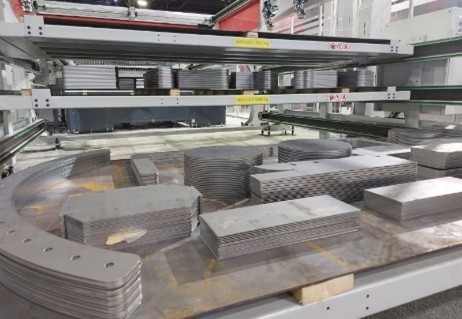
Automation hits the wall once a nest lands on a cart or conveyor. Then an increasingly hard to find material handler is needed to pull, identify, sort, and stack parts. This process often takes longer than actual cutting and mistakes are common. Yet, the focus with most laser venders remains on jacking wattage to shave seconds off of part cycle time. Instead, Astes works smarter, not harder.
The Astes Advantage
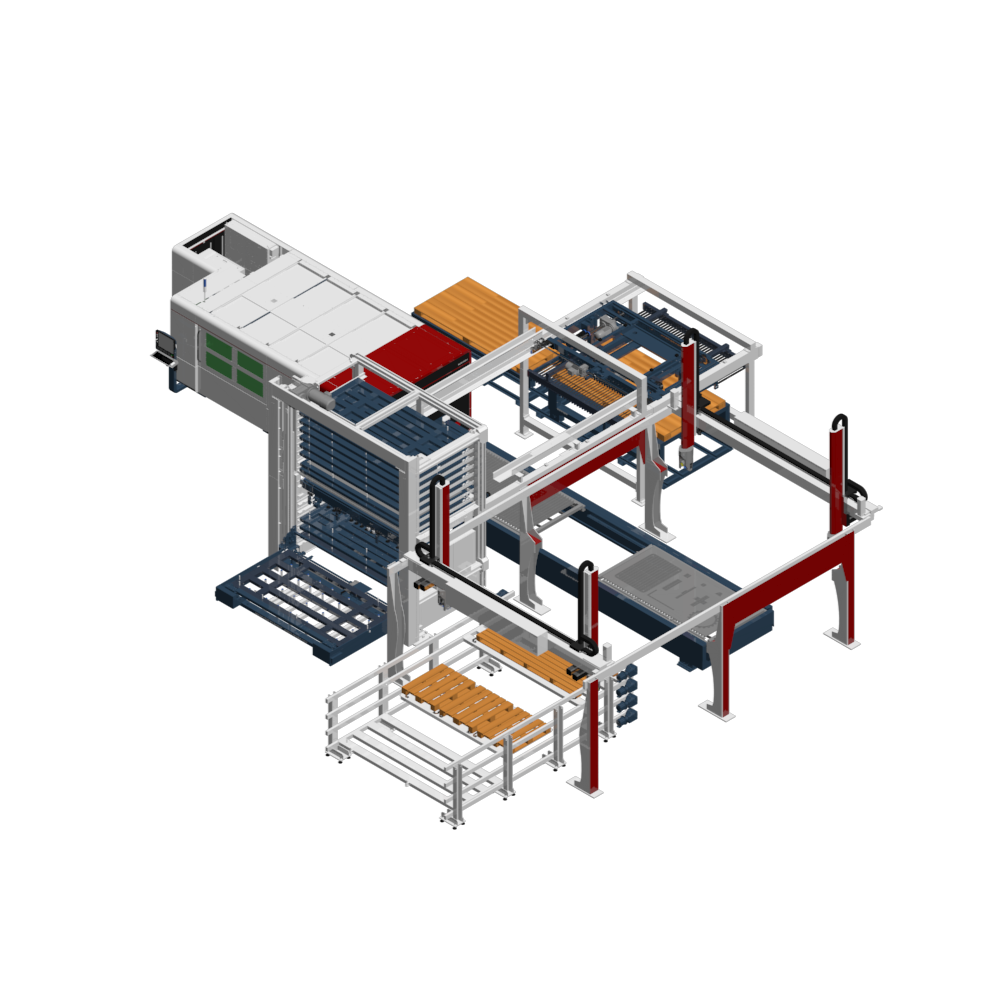
Patented 4-arm system- critical for nesting flexibility and yield
-
- Up to four parts sorted at one time.
- Multiple arms for large, long, or drooping parts.
- Part rotation. Use arms from either gantry to rotate the part during the sort operation. A two arm system can only nest/sort/stack longer parts in one direction.
Astes Knows Part Weight
-
- It varies the degree of magnetism to only apply the required lifting force. Different size suction cups have different pull strengths. Thus if a part is welded into a sheet it doesn’t lift the entire nest and create a mess
SortCam Does the Thinking for You
-
- It knows a part’s center of gravity and how much it will flex. Too much flex and it recognizes that two or three pick points are needed instead of just one. The same for crescent shaped parts where the center of gravity is off the part. Competitive systems can’t do this, and you may need to program an entire denesting system on your own.
Other Astes Features
Full 1.0” Load/Unload Capacity
Fast- the Astes is typically waiting on the laser, not the other way around.
Six Sorting Tools in Each Arm– further decreases sort time because the arms no longer have to drop off and pick up tools as needed.
Heavy Duty– 160 lbs. per arm, 640 lbs. if all four used at once. Higher capacity systems available.
Single Source Support– Astes can be integrated in Europe with other lasers, where it remains the most popular sorting option for Trumpf and Bystronic users. But Mitsubishi has decided to just focus on Mits lasers in North America to insure an optimum user experience.
Don’t need to Sort Everything– due to size, geometry, or run quantity, you may not want to run everything through the Astes. No problem – intact nests can be directed to flow to a cart at the end